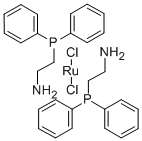

Dichlorobis(2-(diphenylphosphino)ethylamine)ruthenium(II) CAS#: 506417-41-0
IdentificationPhysical DataSpectraRoute of Synthesis (ROS)Safety and HazardsOther Data

Identification

Product NameDichlorobis(2-(diphenylphosphino)ethylamine)ruthenium(II) IUPAC Namedichlororuthenium;2-diphenylphosphanylethanamineMolecular StructureCAS Registry Number 506417-41-0Synonyms506417-41-0Dichlorobis(2-(diphenylphosphino)ethylamine)ruthenium(II)Dichlorobisruthenium(II)dichlororuthenium;2-diphenylphosphanylethanamineSCHEMBL1767611DTXSID30584787MFCD07782004AKOS015900275DB-216527F728762-(Diphenylphosphanyl)ethanamine-dichlororuthenium (2:1)dichlorobisruthenium (ii)2-(Diphenylphosphanyl)ethan-1-amine--dichlororuthenium (2/1)Dichlorobis(2-(diphenylphosphino)ethylamine)ruthenium(II), 95%DICHLOROBISRUTHENIUMMolecular FormulaC28H32Cl2N2P2RuMolecular Weight630.5InChIInChI=1S/2C14H16NP.2ClH.Ru/c2*15-11-12-16(13-7-3-1-4-8-13)14-9-5-2-6-10-14;;;/h2*1-10H,11-12,15H2;2*1H;/q;;;;+2/p-2InChI KeyBJNVYFXBTNBKRU-UHFFFAOYSA-LSMILESC1=CC=C(C=C1)P(CCN)C2=CC=CC=C2.C1=CC=C(C=C1)P(CCN)C2=CC=CC=C2.ClCl

Patent InformationPatent IDTitlePublication DateUS2018/312454PROCESS FOR THE PREPARATION OF DEUTERATED ETHANOL FROM D22018

Physical Data

AppearanceYellow powder

Spectra

Description (NMR Spectroscopy)Nucleus (NMR Spectroscopy)Solvents (NMR Spectroscopy)Temperature (NMR Spectroscopy), °C Frequency (NMR Spectroscopy), MHzChemical shifts31Pdichloromethane-d227161.839Chemical shifts31Pdichloromethane-d227161.8Chemical shifts, Spectrum31P1,4-dioxane-d830162

Route of Synthesis (ROS)

Route of Synthesis (ROS) of Dichlorobis(2-(diphenylphosphino)ethylamine)ruthenium(II) CAS 506417-41-0

ConditionsYieldIn toluene at 100℃; for 6h; Glovebox; Schlenk technique;Experimental Procedure2 0Preparation of (2)In a glove box, (0.25 mmol) was added to a schlenk flask equipped with a magnetic stir bar. The flask was then attached to a schlenk line and 3.4 mL of freshly distilled toluene added. The mixture was then rapidly stirred. A 1.7 mL toluene solution of Ph2PCH2CH2NH2, (0.50 mmol) in an NMR tube was then added via a cannula. Any residue in the NMR tube and cannula was washed into the flask with 1.7 mL of toluene. The light yellow mixture was then heated at 100° C. for 6 h. The yellow suspension that resulted was allowed to cool to RT before collecting the precipitate by filtration under Argon. The precipitate was then washed with 10.0 mL portions of toluene, three times (until colorless). The yellow solid was then dried in vacuo. Yield: 90%. Note: Excessive scraping of the product should be minimised to prevent the build-up of static electricity90%In toluene at 100℃; for 6h; Schlenk technique;90%

Safety and Hazards

GHS Hazard StatementsNot Classified

Other Data

DruglikenessLipinski rules componentMolecular Weight630.499HBA2HBD0Matching Lipinski Rules2Veber rules componentPolar Surface Area (PSA)0Rotatable Bond (RotB)4Matching Veber Rules2

Use PatternDichlorobis(2-(diphenylphosphino)ethylamine)ruthenium(II) CAS#: 506417-41-0 is primarily used as a homogeneous catalyst in hydrogenation, isomerization, and carbon–carbon bond-forming reactions. https://www.chemwhat.com/dichlorobis2-diphenylphosphinoethyla-cas-506417-41-0/

Comments

Popular posts from this blog

Watson's PDHP CAS 34562-31-7 The Secret to Light Yellow Liquid Appearance

In the competitive world of chemical manufacturing, maintaining consistency and meeting precise specifications are essential for success. One compound that highlights these principles is 3,5-Diethyl-1,2-dihydro-1-phenyl-2-propylpyridine, commonly known as PDHP, with the CAS number 34562-31-7. PDHP is a versatile compound utilized in various industrial applications, including rubber additives and catalytic processes. Among its many attributes, Watson’s ability to consistently produce PDHP as a light yellow liquid stands out, especially in industries where the appearance of the final product is crucial. PDHP serves a vital role in several industrial sectors. In the rubber industry, it functions as an additive that enhances the durability and longevity of rubber products. PDHP’s properties help improve the stability of rubber, making it more resistant to environmental wear and tear. Additionally, in catalysis, PDHP’s structure allows it to act as an effective ligand or catalyst precurso...
IdentificationPhysical DataSpectraRoute of Synthesis (ROS)Safety and HazardsOther Data Identification Product Namemethylammonium iodideIUPAC Namemethylazanium;iodide Molecular StructureCAS Registry Number 14965-49-2MDL NumberMFCD28100833SynonymsMethylammonium iodide14965-49-2methylazanium;iodideEINECS 239-037-4methylazanium iodideMethanamine, hydriodideMethyl ammonium iodideMethylamine.hydriodicacidSCHEMBL1534750Methylammonium Iodide, anhydrousDB-221235NS00086090Molecular FormulaCH6INMolecular Weight158.97InChIInChI=1S/CH5N.HI/c1-2;/h2H2,1H3;1HInChI KeyLLWRXQXPJMPHLR-UHFFFAOYSA-N  Canonical SMILESC. Patent InformationPatent IDTitlePublication DateWO2023/180219A METHOD FOR SYNTHESIS OF HALIDE SALTS2023CN113845428Preparation method of perovskite material powder2021WO2018/169373METHOD OF PREPARING LUMINESCENT NANO-SHEET, LUMINESCENT NANO-SHEET MATERIAL, LUMINESCENT NANO-SHEET FILM, BACK LIGHT, AND LIQUID CRYSTAL DISPLAY APPARATUS2018WO2015/32748AMORPHOUS MATERIAL AND THE USE THEREOF2018 ...
IdentificationPhysical DataSpectraRoute of Synthesis (ROS)Safety and HazardsOther Data Identification Product NameNickel HydroxideIUPAC Namenickel;dihydrate Molecular StructureCAS Registry Number 12054-48-7EINECS Number235-008-5MDL NumberMFCD00011140Beilstein Registry NumberSynonyms12054-48-7AKOS015903693CS-0089243dihydroxynickelEC 235-008-5EINECS 235-008-5HSDB 1827LS-96321MFCD00011140Nickel dihydroxideNickel hydroxide (II)Nickel hydroxide (Ni(OH)2)Nickel hydroxide (ous)Nickel Hydroxide nanowireNickel(2+) hydroxidenickel(II) dihydroxideNickel(II) hydroxide, for analysisnickel;dihydrateNickelous hydroxideUNII-L8UW92NW6JMolecular FormulaH4NiO2Molecular Weight94.724 InChIInChI=1S/Ni.2H2O/h;2*1H2 InChI KeyAIBQNUOBCRIENU-UHFFFAOYSA-N  Canonical SMILESO.O.   Physical Data AppearanceGreen powder Spectra Description (IR Spectroscopy)Solvent (IR Spectroscopy)Temperature (IR Spectroscopy), °CBandssolid matrix-258 Description (UV/VIS Spectroscopy)Solvent (UV/VIS Spectroscopy)Comment (UV/VIS Spec...