IdentificationPhysical DataSpectraRoute of Synthesis (ROS)Safety and HazardsOther Data
Identification
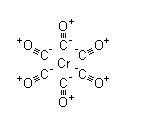
Product NameChromium hexacarbonylIUPAC Namecarbon monoxide;chromiumMolecular StructureCAS Registry Number 13007-92-6EINECS Number235-852-4MDL NumberMFCD00010945Beilstein Registry NumberNo data availableSynonymschromium(0) hexacarbonyl, hexa-carbonylchromate(0), hexacarbonyl chromium(0), hexacarbonylchromate(0), hexacarbonylchromium(0), hexacarbonylchromium(O), chromium hexacarbonyl; CAS Number: 13007-92-6;CAS No.:13007-92-6Molecular FormulaC6CrO6Molecular Weight220.057InChIInChI=1S/6CO.Cr/c6*1-2;InChI KeyKOTQLLUQLXWWDK-UHFFFAOYSA-NCanonical SMILES#.#.#.#.#.#.
Patent InformationPatent IDTitlePublication DateWO2008/77911LIGANDS AND CATALYST SYSTEMS FOR THE OLIGOMERIZATION OF OLEFINIC MONOMERS2008
Physical Data
AppearanceWhite crystalSolubilityinsolubleRefractive index1.5560 (estimate)
Melting Point, °C Comment (Melting Point)130with decomposition149 - 150
Boiling Point, °CPressure (Boiling Point), Torr147.4760
Density, g·cm-3Measurement Temperature, °CType (Density)-173.16crystallographic1.865-173.16crystallographic1.768crystallographic1.766 - 1.772crystallographic1.77crystallographic1.7718
Description (Association (MCS))Comment (Adsorption (MCS))Partner (Association (MCS))Adsorptionsorption diagramα-Fe2O3(0001)MCM-41Adsorptionsorption diagramsilicaAdsorptionPdsilica-aluminaAdsorptionsilicaAdsorptionCu(100)
Spectra
Description (NMR Spectroscopy)Nucleus (NMR Spectroscopy)Solvents (NMR Spectroscopy)Temperature (NMR Spectroscopy), °C 13Cchloroform-d18013CCD2Cl2-63.16Spectrum13CC6D5CD3=toluene-d8-43.15Linewidth of NMR absorption13CCDCl321Linewidth of NMR absorption17OCDCl33813Cmethylene chloride=methylene dichloride22
Description (IR Spectroscopy)Solvent (IR Spectroscopy)Temperature (IR Spectroscopy), °CSignals, cm-1Intensity of IR bands, Bandspotassium bromideSpectrumcyclohexane25BandshexaneBandstetrahydrofuran1983Bandsgaseous matrix-261.161984BandsKBr1999Spectrumfurther solvent(s)Spectrumgaseous matrix-261.16
Chromium hexacarbonyl CAS 13007-92-6 IRChromium hexacarbonyl CAS 13007-92-6 XRDChromium hexacarbonyl CAS 13007-92-6 HPLCHPLC ConditionsColumn : 250 mm×4.6 mm 5μm ; Wavelength : 240 nm ; Temperature : 35°C ; Flowing rate : 1.0 ml/min ; Injection volume : 5μL ; Time : 20 min ; Mobile phase : Water : Acetonitrile = 32 : 68 ; Preparation : Transfer 0.1 grams of the sample into a 100 mL volumetric flask, and dissolve it to volume with chromatography-grade n-hexane using ultrasonication.
Description (Mass Spectrometry)Comment (Mass Spectrometry)SpectrumFragmentation patternSpectrumMolecular peak, Fragmentation patternMolecular peakMolecular peak, Fragmentation patternmass spectrometry
Description (UV/VIS Spectroscopy)Solvent (UV/VIS Spectroscopy)Comment (UV/VIS Spectroscopy)Absorption Maxima (UV/VIS), nmSpectrum, Band assignmentgas200 nm - 400 nmSpectrum, Band assignmentneat (no solvent, gas phase)200 nm - 400 nmSpectrumCHCl3220 nm - 500 nm258Band assignmentacetonitrile2.88 eV - 5.11 eV250 nm - 355 nmSpectrumhexane200 nm - 500 nmBand assignmentcyclohexane280
Description (Raman Spectroscopy)BandsRaman
Route of Synthesis (ROS)
Route of Synthesis (ROS) of Chromium hexacarbonyl CAS 13007-92-6
ConditionsYieldIn diethylene glycol mixt. Cr(CO)6 and bis(diphenylphosphino)methane in diglyme was heated at 135°C for 3.5 h;82%in boiling solvent or in bomb tube at 140-190°C;;77%In diethylene glycol other Radiation; mixt. Cr(CO)6 and 10 % excess bis(diphenylphosphino)methane was suspended in diglyme and under microwave irradiation was heated at 180°Cfor 5 min; react. mixt. was cooled to room temp., methanol was added, ppt. was collected by filtration and dried in vacuo; elem. anal.;55%With sodium tetrahydroborate In butan-1-ol at 105℃; under 760.051 Torr; for 0.333333h; Microwave irradiation; Inert atmosphere; Green chemistry;54%In tetrahydrofuran Irradiation (UV/VIS); (Ar); photolysis of a soln. of chromium complex and ligand in THF for 45min, stirring for 2 h; concn., column chromy. (silica gel, CH2Cl2/hexanes 1:10);26%
Safety and Hazards
Pictogram(s)SignalDangerGHS Hazard StatementsH301 (93.48%): Toxic if swallowed H331 (10.87%): Toxic if inhaled Information may vary between notifications depending on impurities, additives, and other factors. Precautionary Statement CodesP261, P264, P270, P271, P301+P310, P304+P340, P311, P321, P330, P403+P233, P405, and P501(The corresponding statement to each P-code can be found at the GHS Classification page.)
Other Data
TransportationClass 6.1; Packaging Group: III; UN Number:3466Under the room temperature and away from lightHS Code293190StorageUnder the room temperature and away from lightShelf Life1 yearMarket PriceUSD 4500/kg
DruglikenessLipinski rules componentMolecular Weight220.058logP0.402HBA6HBD0Matching Lipinski Rules4Veber rules componentPolar Surface Area (PSA)102.42Rotatable Bond (RotB)6Matching Veber Rules2
Laboratory Use and HandlingUse PatternPreparation of adducts with carbon nanotubesdissotiates under modulated MIR pulsesinformation on usestable in weakly basic mediaundergoes thermal decompn. at 503-613 Kin solution sensitive to lightstable only in the dark; ppt. of brown flakes in diffuse light;decomposition with fuming nitric acid and indifferent against cold KOH, mineral acids, Br2, I2
https://www.chemwhat.com/chromium-hexacarbonyl-cas-13007-92-6/

Comments
Post a Comment