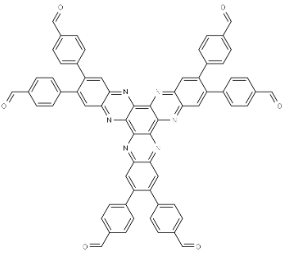

2,3,8,9,14,15-hexa(4-formylphenyl)diquinoxalinophenazine CAS#: 2307218-00-2
IdentificationPhysical DataSpectraRoute of Synthesis (ROS)Safety and HazardsOther Data

Identification

Product Name2,3,8,9,14,15-hexa(4-formylphenyl)diquinoxalinophenazineIUPAC Name4-triaconta-1(30),2,4(9),5,7,10,12,14(19),15,17,20,22,24(29),25,27-pentadecaen-6-yl]benzaldehydeMolecular StructureCAS Registry Number 2307218-00-2Synonyms3-Pyridinamin;3-Pyridinamine;3-Pyridinamine;pyridin-3-amine;T6NJ CZ;3- Aminopyridine;3-Amino-pyridine;3-p2307218-00-24,4',4'',4''',4'''',4'''''-(Diquinoxalinophenazine-2,3,8,9,14,15-hexayl)hexabenzaldehyde2,3,8,9,14,15-Hexa(4-formylphenyl)diquinoxalinophenazineCS-01703694-triaconta-1(30),2,4,6,8,10,12,14,16,18,20,22,24,26,28-pentadecaen-6-yl]benzaldehydeMolecular FormulaC66H36N6O6Molecular Weight1009InChIInChI=1S/C66H36N6O6/c73-31-37-1-13-43(14-2-37)49-25-55-56(26-50(49)44-15-3-38(32-74)4-16-44)68-62-61(67-55)63-65(71-58-28-52(46-19-7-40(34-76)8-20-46)51(27-57(58)69-63)45-17-5-39(33-75)6-18-45)66-64(62)70-59-29-53(47-21-9-41(35-77)10-22-47)54(30-60(59)72-66)48-23-11-42(36-78)12-24-48/h1-36HInChI KeyRSRGRQWCLRRNSQ-UHFFFAOYSA-NSMILESC1=CC(=CC=C1C=O)C2=CC3=C(C=C2C4=CC=C(C=C4)C=O)N=C5C(=N3)C6=NC7=C(C=C(C(=C7)C8=CC=C(C=C8)C=O)C9=CC=C(C=C9)C=O)N=C6C1=NC2=C(C=C(C(=C2)C2=CC=C(C=C2)C=O)C2=CC=C(C=C2)C=O)N=C51

Physical Data

No data available

Spectra

Description (NMR Spectroscopy)Nucleus (NMR Spectroscopy)Solvents (NMR Spectroscopy)Temperature (NMR Spectroscopy), °C Frequency (NMR Spectroscopy), MHzChemical shifts1Hdichloromethane-d225300Chemical shifts, Spectrum1Hchloroform-d120300COSY (Correlation Spectroscopy), Spectrum1H, 1Hchloroform-d120126NOESY (Nuclear Overhauser Enhanced Spectroscopy), Spectrum1H, 1Hchloroform-d120126HSQC (Heteronuclear Single Quantum Coherence), Spectrum1H, 13Cchloroform-d120126Chemical shifts, Spectrum13Cchloroform-d120126

2,3,8,9,14,15-hexa(4-formylphenyl)diquinoxalinophenazine CAS#: 2307218-00-2 NMR

Description (UV/VIS Spectroscopy)Solvent (UV/VIS Spectroscopy)Spectrumisopropyl alcohol

Route of Synthesis (ROS)

Route of Synthesis (ROS) of 2,3,8,9,14,15-hexa(4-formylphenyl)diquinoxalinophenazine CAS 2307218-00-2

ConditionsYieldWith tetrakis-(triphenylphosphine)-palladium; potassium carbonate In water monomer; N,N-dimethyl-formamide at 90℃; for 72h; Suzuki Coupling; Inert atmosphere;80%With tetrakis-(triphenylphosphine)-palladium; potassium carbonate In water monomer; N,N-dimethyl-formamide at 100℃; for 72h; Schlenk technique; Inert atmosphere;77%

Safety and Hazards

No data available

Other Data

DruglikenessLipinski rules componentMolecular Weight1009.05logP12.99HBA12HBD0Matching Lipinski Rules1Veber rules componentPolar Surface Area (PSA)179.76Rotatable Bond (RotB)12Matching Veber Rules0

Use Pattern2,3,8,9,14,15-hexa(4-formylphenyl)diquinoxalinophenazine CAS#: 2307218-00-2 is usually used as a OLED material. https://www.chemwhat.com/23891415-hexa4-formylphenyldiquinoxalino23-a2%e2%80%b23%e2%80%b2-cphenazine-cas-2307218-00-2/

Comments

Popular posts from this blog

The World's Largest Producer of Squaric Acid Emerges: Watson Leads the Way

In a groundbreaking development for the chemical industry, Watson has officially claimed the title of the world’s largest producer of squaric acid. This achievement marks a significant milestone, positioning the company as a global leader in the production of this highly versatile compound, widely valued in pharmaceuticals, polymer research, and advanced materials. What is Squaric Acid? Squaric acid, also known as quadratic acid, is a four-carbon cyclic diketone with two ketone groups and two hydroxyl groups arranged symmetrically. It is renowned for its stability and strong acidity, making it a unique compound in both organic and inorganic chemistry. Its derivatives find applications in creating advanced coatings, conductive polymers, and as intermediates in drug synthesis. Watson: Redefining Excellence in Squaric Acid Production Watson’s rise to the top of the squaric acid industry is backed by its unmatched production capacity, cutting-edge technology, and unwavering commitment...
Names & IdentifiersProduct NameHYDROXYPROPYL CHITOSANSynonymsN-(2-Hydroxypropyl)chitosanCAS Registry Number104673-29-2Molecular FormulaMolecular Weight0EINECSOther Registry NumbersMore Identifiers on PubChemIUPA Names, InChI, InChI Key, Canonical SMILES, etc.Chemical & Physical Properties Safety & Hazards(Codes & Phrases) More Safety & Hazards From PubChem Signal, GHS Hazard Statements, Precautionary Statement Codes, etc. Literature Literature on PubChem Synthesis References, Metabolite References, etc. Patents Patents on PubChem Related Patents Of This Product Transportation, Storage & Usage Transportation No Information Storage No Information Usage No Information Spectral Properties No Information https://www.chemwhat.com/hydroxypropyl-chitosan-cas-104673-29-2/
IdentificationPhysical DataSpectraRoute of Synthesis (ROS)Safety and HazardsOther Data Identification Product Namemethylammonium iodideIUPAC Namemethylazanium;iodide Molecular StructureCAS Registry Number 14965-49-2MDL NumberMFCD28100833SynonymsMethylammonium iodide14965-49-2methylazanium;iodideEINECS 239-037-4methylazanium iodideMethanamine, hydriodideMethyl ammonium iodideMethylamine.hydriodicacidSCHEMBL1534750Methylammonium Iodide, anhydrousDB-221235NS00086090Molecular FormulaCH6INMolecular Weight158.97InChIInChI=1S/CH5N.HI/c1-2;/h2H2,1H3;1HInChI KeyLLWRXQXPJMPHLR-UHFFFAOYSA-N  Canonical SMILESC. Patent InformationPatent IDTitlePublication DateWO2023/180219A METHOD FOR SYNTHESIS OF HALIDE SALTS2023CN113845428Preparation method of perovskite material powder2021WO2018/169373METHOD OF PREPARING LUMINESCENT NANO-SHEET, LUMINESCENT NANO-SHEET MATERIAL, LUMINESCENT NANO-SHEET FILM, BACK LIGHT, AND LIQUID CRYSTAL DISPLAY APPARATUS2018WO2015/32748AMORPHOUS MATERIAL AND THE USE THEREOF2018 ...