IdentificationPhysical DataSpectraRoute of Synthesis (ROS)Safety and HazardsOther Data
Identification
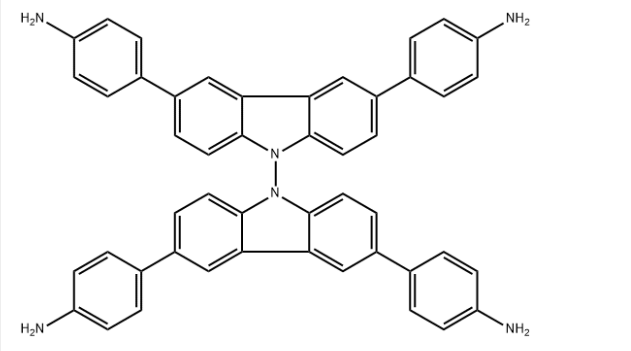
Product NameBCTA-4NH2IUPAC Name4-carbazol-3-yl]anilineMolecular StructureCAS Registry Number 2559708-42-6Synonyms2559708-42-64,4',4'',4'''-(-3,3',6,6'-tetrayl)tetraaniline4,4',4",4"'-(-3,3',6,6'-tetrayl)tetraanilineBS-53529CS-0170121G698554--3-yl]aniline4,4',4 ,4 '-(-3,3',6,6'-tetrayl)tetraaniline4-carbazol-3-yl]anilineMolecular FormulaC48H36N6 Molecular Weight696.8InChIInChI=1S/C48H36N6/c49-37-13-1-29(2-14-37)33-9-21-45-41(25-33)42-26-34(30-3-15-38(50)16-4-30)10-22-46(42)53(45)54-47-23-11-35(31-5-17-39(51)18-6-31)27-43(47)44-28-36(12-24-48(44)54)32-7-19-40(52)20-8-32/h1-28H,49-52H2InChI KeyFCLCXBZRRFKRGK-UHFFFAOYSA-NSMILESC1=CC(=CC=C1C2=CC3=C(C=C2)N(C4=C3C=C(C=C4)C5=CC=C(C=C5)N)N6C7=C(C=C(C=C7)C8=CC=C(C=C8)N)C9=C6C=CC(=C9)C1=CC=C(C=C1)N)N
Physical Data
AppearanceYellow to white powder
Spectra
No data available
Route of Synthesis (ROS)
No data avaliable
Safety and Hazards
No data avaliable
Other Data
TransportationStore at 2-8°C away from light for long time storageHS CodeStorageStore at 2-8°C away from light for long time storageShelf Life1 yearMarket Price
Use PatternBCTA-4NH2known as TAPC, is an organic compound with a wide range of applications. One of its primary uses is in the field of organic electronics, where it is used as a hole-transport material in organic light-emitting diodes (OLEDs) and organic photovoltaics (OPVs).In OLEDs, TAPC can act as a highly efficient hole-transporting layer, helping to improve the efficiency and stability of the device. It is particularly useful in the production of blue-emitting OLEDs, where its unique properties allow for improved performance. Additionally, TAPC can be used as a host material in the production of OLEDs, where it helps to enhance the luminance and efficiency of the device.In OPVs, TAPC can be used as a hole-transporting material in the active layer of the device. It has been shown to improve the power conversion efficiency of OPVs, making them a more viable option for renewable energy production.TAPC can also be used as a dye in the field of bioimaging, where it can be used to label and visualize biological molecules such as DNA and proteins. Its unique optical properties make it an excellent candidate for fluorescent labeling, allowing for precise detection and analysis of biological processes. https://www.chemwhat.com/bcta-4nh2-cas-2559708-42-6/
Comments
Post a Comment