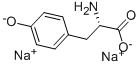

L-TYROSINE DISODIUM SALT CAS#: 122666-87-9
IdentificationPhysical DataSpectraRoute of Synthesis (ROS)Safety and HazardsOther Data

Identification

Product NameL-TYROSINE DISODIUM SALT IUPAC Namedisodium;(2S)-2-amino-3-(4-oxidophenyl)propanoate;dihydrateMolecular StructureCAS Registry Number 122666-87-9Synonyms122666-87-9Tyrosine disodium dihydrateL-Tyrosine disodium saltL-Tyrosine disodium salt dihydrateUNII-5RFD27DQ22L-Tyrosine, disodium salt, dihydrate5RFD27DQ22L-Tyrosine, sodium salt, hydrate (1:2:2)disodium;(2S)-2-amino-3-(4-oxidophenyl)propanoate;dihydrateMFCD03840558DTXSID50153676disodium,(2S)-2-amino-3-(4-oxidophenyl)propanoate,dihydrateD78280Q27262780Molecular FormulaC9H13NNa2O5Molecular Weight261.18InChIInChI=1S/C9H11NO3.2Na.2H2O/c10-8(9(12)13)5-6-1-3-7(11)4-2-6;;;;/h1-4,8,11H,5,10H2,(H,12,13);;;2*1H2/q;2*+1;;/p-2/t8-;;;;/m0..../s1 InChI KeyWFTCFVUQORELJZ-USHJOAKVSA-L Isomeric SMILESC1=CC(=CC=C1C(C(=O))N).O.O..

Physical Data

AppearanceYellowish or off-white crystalline powder

Spectra

No data available

Route of Synthesis (ROS)

No data available

Safety and Hazards

Pictogram(s)SignalDangerGHS Hazard StatementsH315 (33.3%): Causes skin irritation H318 (66.7%): Causes serious eye damage H335 (16.7%): May cause respiratory irritation Precautionary Statement CodesP261, P264, P264+P265, P271, P280, P302+P352, P304+P340, P305+P354+P338, P317, P319, P321, P332+P317, P362+P364, P403+P233, P405, and P501(The corresponding statement to each P-code can be found at the GHS Classification page.)

Other Data

TransportationStore at room temperature, in container tightly sealed; Protect from light.HS CodeStorageStore at room temperature, in container tightly sealed; Protect from light.Shelf Life2 yearsMarket Price

Use PatternL-Tyrosine disodium salt can be used as a nutritional fortifier in food products. It is commonly found in sports nutrition products and energy drinks, helping to boost protein synthesis, promote muscle repair, and enhance physical performance.L-Tyrosine disodium salt is widely used in laboratories for biochemical research, serving as a key reagent in protein synthesis, enzyme reactions, and other experiments. https://www.chemwhat.com/l-tyrosine-disodium-salt-cas-122666-87-9/

Comments

Popular posts from this blog

Watson's PDHP CAS 34562-31-7 The Secret to Light Yellow Liquid Appearance

In the competitive world of chemical manufacturing, maintaining consistency and meeting precise specifications are essential for success. One compound that highlights these principles is 3,5-Diethyl-1,2-dihydro-1-phenyl-2-propylpyridine, commonly known as PDHP, with the CAS number 34562-31-7. PDHP is a versatile compound utilized in various industrial applications, including rubber additives and catalytic processes. Among its many attributes, Watson’s ability to consistently produce PDHP as a light yellow liquid stands out, especially in industries where the appearance of the final product is crucial. PDHP serves a vital role in several industrial sectors. In the rubber industry, it functions as an additive that enhances the durability and longevity of rubber products. PDHP’s properties help improve the stability of rubber, making it more resistant to environmental wear and tear. Additionally, in catalysis, PDHP’s structure allows it to act as an effective ligand or catalyst precurso...
IdentificationPhysical DataSpectraRoute of Synthesis (ROS)Safety and HazardsOther Data Identification Product Namemethylammonium iodideIUPAC Namemethylazanium;iodide Molecular StructureCAS Registry Number 14965-49-2MDL NumberMFCD28100833SynonymsMethylammonium iodide14965-49-2methylazanium;iodideEINECS 239-037-4methylazanium iodideMethanamine, hydriodideMethyl ammonium iodideMethylamine.hydriodicacidSCHEMBL1534750Methylammonium Iodide, anhydrousDB-221235NS00086090Molecular FormulaCH6INMolecular Weight158.97InChIInChI=1S/CH5N.HI/c1-2;/h2H2,1H3;1HInChI KeyLLWRXQXPJMPHLR-UHFFFAOYSA-N  Canonical SMILESC. Patent InformationPatent IDTitlePublication DateWO2023/180219A METHOD FOR SYNTHESIS OF HALIDE SALTS2023CN113845428Preparation method of perovskite material powder2021WO2018/169373METHOD OF PREPARING LUMINESCENT NANO-SHEET, LUMINESCENT NANO-SHEET MATERIAL, LUMINESCENT NANO-SHEET FILM, BACK LIGHT, AND LIQUID CRYSTAL DISPLAY APPARATUS2018WO2015/32748AMORPHOUS MATERIAL AND THE USE THEREOF2018 ...
IdentificationPhysical DataSpectraRoute of Synthesis (ROS)Safety and HazardsOther Data Identification Product NameNickel HydroxideIUPAC Namenickel;dihydrate Molecular StructureCAS Registry Number 12054-48-7EINECS Number235-008-5MDL NumberMFCD00011140Beilstein Registry NumberSynonyms12054-48-7AKOS015903693CS-0089243dihydroxynickelEC 235-008-5EINECS 235-008-5HSDB 1827LS-96321MFCD00011140Nickel dihydroxideNickel hydroxide (II)Nickel hydroxide (Ni(OH)2)Nickel hydroxide (ous)Nickel Hydroxide nanowireNickel(2+) hydroxidenickel(II) dihydroxideNickel(II) hydroxide, for analysisnickel;dihydrateNickelous hydroxideUNII-L8UW92NW6JMolecular FormulaH4NiO2Molecular Weight94.724 InChIInChI=1S/Ni.2H2O/h;2*1H2 InChI KeyAIBQNUOBCRIENU-UHFFFAOYSA-N  Canonical SMILESO.O.   Physical Data AppearanceGreen powder Spectra Description (IR Spectroscopy)Solvent (IR Spectroscopy)Temperature (IR Spectroscopy), °CBandssolid matrix-258 Description (UV/VIS Spectroscopy)Solvent (UV/VIS Spectroscopy)Comment (UV/VIS Spec...