IdentificationPhysical DataSpectraRoute of Synthesis (ROS)Safety and HazardsOther Data
Identification
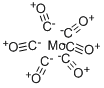
Product NameMolybdenum hexacarbonyl IUPAC Namearbon monoxide;molybdenum Molecular StructureCAS Registry Number 13939-06-5EINECS Number237-713-3MDL NumberMFCD00003466Synonyms3-Pyridinamin;3-Pyridinamine;3-Pyridinamine;pyridin-3-amine;T6NJ CZ;3- Aminopyridine;3-Amino-pyridine;3-pyridylamine;Amino-3 pyridine;m-Aminopyridine;MS/MS-1064463;Pyridin-3-ylamine;Pyridine, 3-amino-;β-Aminopyridine462-08-8Molybdenumhexacarbonyl13939-06-5carbon monoxide;molybdenumSTR06546AKOS037655893hexakis(methanidylidyneoxidanium) molybdenumFT-0689151D958603-Pyridinamin;3-Pyridinamine;3-Pyridinamine;pyridin-3-amine;T6NJ CZ;3- Aminopyridine;3-Amino-pyridine;3-pyridylamine;Amino-3 pyridine;m-Aminopyridine;MS/MS-1064463;Pyridin-3-ylamine;Pyridine, 3-amino-;β-Aminopyridine462-08-8Molecular FormulaC6MoO6 Molecular Weight264.01InChIInChI=1S/6CO.Mo/c6*1-2InChI KeyKMKBZNSIJQWHJA-UHFFFAOYSA-N Isomeric SMILES#.#.#.#.#.#.
Patent InformationPatent IDTitlePublication DateUS2012/40984THIADIAZOLE AND OXADIAZOLE DERIVATIVES, PREPARATION THEREOF AND THERAPEUTIC USE THEREOF2012
Physical Data
AppearanceWhite powder
Spectra
No data available
Route of Synthesis (ROS)
Route of Synthesis (ROS) of Molybdenum hexacarbonyl CAS13939-06-5
With water; sodium carbonate; palladium diacetate; tri tert-butylphosphoniumtetrafluoroborate In 1,2-dimethoxyethane at 120℃; for 1h; Microwave irradiation;Experimental ProcedureExample 674-sulfonyl]-5-trifluoromethyl-1H-indol-2-yl]methyl]-3-fluorobenzoic acidA mixture of 136 mg (0.24 mM) of 2--1-sulfonyl]-5-trifluoromethyl-1H-indole (preparation XXIII), 5.37 mg (0.02 mM) of palladium acetate, 6.94 mg (0.02 mM) of triterbutylphosphonium tetrafluoroborate, 94.75 mg (0.36 mM) of molybdenum hexacarbonyl, 38.04 mg (0.36 mM) of sodium carbonate in 1.63 mL of DME and 0.54 mL of water was heated for 1 hour at 120° C. in microwave equipment. The reaction mixture was filtered on paper and the filtrate was evaporated. The residue obtained was purified by preparative liquid chromatography, eluting with H2O/CH3CN/0.1% TFA mixture. The fractions containing the expected product were combined and concentrated to dryness under reduced pressure to give 101 mg of 4-sulfonyl]-5-trifluoro methyl-1H-indol-2-yl]methyl]-3-fluorobenzoic acid as a white solid (yield=79%). M.p.=177° C.79%
Safety and Hazards
Pictogram(s)SignalDangerGHS Hazard StatementsH300 (100%): Fatal if swallowed H310 (94.29%): Fatal in contact with skin H330 (100%): Fatal if inhaled Precautionary Statement CodesP260, P262, P264, P270, P271, P280, P284, P301+P316, P302+P352, P304+P340, P316, P320, P321, P330, P361+P364, P403+P233, P405, and P501(The corresponding statement to each P-code can be found at the GHS Classification page.)
Other Data
Shelf Life2 yearsMarket Price
DruglikenessLipinski rules componentMolecular Weight264.002logPHBA6HBD0Matching Lipinski Rules3Veber rules componentPolar Surface Area (PSA)0Rotatable Bond (RotB)0Matching Veber Rules2
Use PatternMolybdenum hexacarbonyl CAS#: 13939-06-5 Molybdenum hexacarbonyl is a coordination compound formed by the transition metal molybdenum and carbon monoxide ligands. And It is a white powder, volatile, and stable in air. It is used as a catalyst, a raw material for molybdenum deposition by thermal decomposition, and an intermediate in organic synthesis.
https://www.chemwhat.com/molybdenum-hexacarbonyl-cas-13939-06-5/
Comments
Post a Comment