IdentificationPhysical DataSpectraRoute of Synthesis (ROS)Safety and HazardsOther Data
Identification
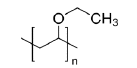
Product NamePOLY(VINYL ETHYL ETHER)IUPAC NameethenoxyethaneMolecular StructureCAS Registry Number 25104-37-4EINECS Number204-085-7MDL NumberMFCD0008446Beilstein Registry NumberNo data availableSynonymsethyl vinyl ethervinyl ethyl etherethylvinyletherMolecular FormulaC4H8N2S4Molecular Weight212.38InChIInChI=1S/C4H8N2S4/c7-3(8)5-1-2-6-4(9)10/h1-2H2,(H2,5,7,8)(H2,6,9,10)InChI KeyAWYFNIZYMPNGAI-UHFFFAOYSA-NCanonical SMILESC(CNC(=S)S)NC(=S)S
Patent InformationPatent IDTitlePublication DateWO2021/51092-(2,4,5-TRIMETHYLCYCLOHEX-2-EN-1-YL)ACETALDEHYDE AND DERIVATIVES AND THEIR USE AS AROMA CHEMICALS2021JP2021/63012METHOD FOR PRODUCING FLUOROALKYLVINYL ETHER2021US2021/122769SILOXANE COMPOUND AND A METHOD FOR PREPARING THE SAME2021
Physical Data
AppearanceResin solutionSolubilityNo data availableFlash Point9°C Refractive indexn20/D 1.454(lit.)SensitivityNo data available
Melting Point, °C Solvent (Melting Point) -115.4-115.8
Boiling Point, °CPressure (Boiling Point), Torr334076030680
Refractive IndexWavelength (Refractive Index), nmTemperature (Refractive Index), °C1.3775589201.3796589251.37658920
Density, g·cm-3Reference Temperature, °CMeasurement Temperature, °C0.7594200.73400.75334200.762514.517.5
Description (Association (MCS))Solvent (Association (MCS))Temperature (Association (MCS)), °CPartner (Association (MCS))Further physical properties of the complexH2O24.85dimethyl sulfoxideStability constant of the complex with ...CCl424.94-FluorophenolAssociation with compoundacrylonitrile, cyclohexaneDipole moment of the complexcyclohexaneacrylonitrileFurther physical properties of the complexacrylonitrile, cyclohexane
Spectra
Description (NMR Spectroscopy)Nucleus (NMR Spectroscopy)Solvents (NMR Spectroscopy)Temperature (NMR Spectroscopy), °C Frequency (NMR Spectroscopy), MHzChemical shifts, Spectrum1Hbenzene-d626.84300Spectrum1H500Chemical shifts, Spectrum1HCD2Cl220Spin-spin coupling constantsacetone-d6
Description (IR Spectroscopy)Solvent (IR Spectroscopy)Temperature (IR Spectroscopy), °CComment (IR Spectroscopy)Spectrumambient temperatureBands3050 - 1203 cm**(-1)Spectrumgas3136 - 131 cm**(-1)Spectrumsolid-253.2 - -193.23115 - 73 cm**(-1)
Description (Mass Spectrometry)Comment (Mass Spectrometry)collisional activationspectrummetastable ions, collisional activationspectrumcollisional activationion-cyclotron resonance
Description (UV/VIS Spectroscopy)Solvent (UV/VIS Spectroscopy)Absorption Maxima (UV/VIS), nmExt./Abs. Coefficient, l·mol-1cm-1SpectrumbenzeneAbsorption maxima1961000Absorption maximahexane1968912UV/VISSpectrumH2SO4
Route of Synthesis (ROS)
Route of Synthesis (ROS) of POLY(VINYL ETHYL ETHER) CAS# 25104-37-4
ConditionsYieldWith pyridine In dichloromethane at 0 - 20℃; for 18h;95%With pyridine In dichloromethane95%With dmap In dichloromethane at -10 - 0℃; for 8h;87%
Safety and Hazards
Pictogram(s)SignalDangerGHS Hazard StatementsH225 (29%): Highly Flammable liquid and vapor H319 (76.86%): Causes serious eye irritation H335 (20.6%): May cause respiratory irritation H412 (19.33%): Harmful to aquatic life with long lasting effects Information may vary between notifications depending on impurities, additives, and other factors. Precautionary Statement CodesP210, P233, P240, P241, P242, P243, P261, P264+P265, P271, P273, P280, P303+P361+P353, P304+P340, P305+P351+P338, P319, P337+P317, P370+P378, P403+P233, P403+P235, P405, and P501(The corresponding statement to each P-code can be found at the GHS Classification page.)
Other Data
TransportationThis product has a shelf life of less than 12 months in unopened, original containers at temperature between 10-30ºC.HS CodeNo data availableStorageThis product has a shelf life of less than 12 months in unopened, original containers at temperature between 10-30ºC.Shelf Life12 monthsMarket PriceUSD
DruglikenessLipinski rules componentMolecular Weight72.1069logP1.247HBA1HBD0Matching Lipinski Rules4Veber rules componentPolar Surface Area (PSA)9.23Rotatable Bond (RotB)2Matching Veber Rules2
BioactivityIn vitro: EfficacyQuantitative Results
pXParameterValue (quant)Biological Species2.82pIC50(Anesthetic activity) 2.82mouse
Quantitative Results1 of 2Assay DescriptionPartition coefficient of the compound in water octanol system was determined MeasurementPartition coefficient2 of 2Assay DescriptionPotency of the compound was determined in relation to octanol-water partition coefficient
Use PatternPOLY(VINYL ETHYL ETHER) CAS#: 25104-37-4 VolatilePOLY(VINYL ETHYL ETHER) CAS#: 25104-37-4 Additive for adhesives.Unstable in the presence of acidsSaponification-resistant soft resin for increasing the adhesion and flexibility of printing inks and cellulose nitrate coatings.It is a polyvinylether resin solution that is mainly used as plasticizing soft resins for cellulose nitrate coatings. Its soft-resin character also improves adhesion in these coatings.
https://www.chemwhat.com/polyvinyl-ethyl-ether-cas-25104-37-4/

Comments
Post a Comment