IdentificationPhysical DataSpectraRoute of Synthesis (ROS)Safety and HazardsOther Data
Identification
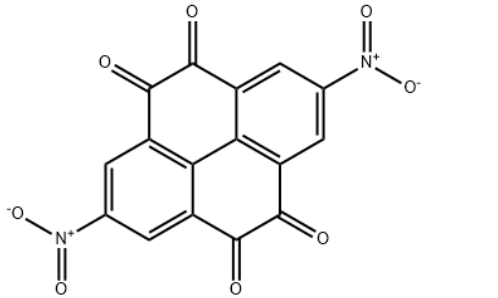
Product Name2,7-dinitropyrene-4,5,9,10-tetraoneIUPAC Name2,7-dinitropyrene-4,5,9,10-tetrone Molecular StructureCAS Registry Number 2151811-65-1Synonyms2,7-dinitropyrene-4,5,9,10-tetraone2151811-65-12,7-Dnitropyrene-4,5,9,10-tetraoneSCHEMBL28632524G66032Molecular FormulaC16H4N2O8Molecular Weight352.21InChIInChI=1S/C16H4N2O8/c19-13-7-1-5(17(23)24)2-8-11(7)12-9(14(13)20)3-6(18(25)26)4-10(12)16(22)15(8)21/h1-4HInChI KeyPLIPECIYPPCLQA-UHFFFAOYSA-NSMILESC1=C(C=C2C3=C1C(=O)C(=O)C4=C3C(=CC(=C4)(=O))C(=O)C2=O)(=O)
Physical Data
No data available
Spectra
Description (NMR Spectroscopy)Nucleus (NMR Spectroscopy)Solvents (NMR Spectroscopy)Temperature (NMR Spectroscopy), °C Frequency (NMR Spectroscopy), MHzSpectrum13Cdimethylsulfoxide-d6Chemical shifts1Hdimethylsulfoxide-d624.84Chemical shifts, Spectrum1Hdimethylsulfoxide-d624.84Chemical shifts, Spectrum1Hdimethylsulfoxide-d6Chemical shifts, Spectrum13Cdimethylsulfoxide-d6Chemical shifts1Hdimethylsulfoxide-d6500Chemical shifts13Cdimethylsulfoxide-d6
2,7-dinitropyrene-4,5,9,10-tetraone CAS#: 2151811-65-1 NMR
Description (IR Spectroscopy)Solvent (IR Spectroscopy)SpectrumBandspotassium bromide
Description (UV/VIS Spectroscopy)Absorption Maxima (UV/VIS), nmN,N-dimethyl-formamide279, 343
Route of Synthesis (ROS)
Route of Synthesis (ROS) of 2,7-dinitropyrene-4,5,9,10-tetraone CAS 2151811-65-1
ConditionsYieldWith sulfuric acid; nitric acid at 85℃; for 0.75h; Cooling with ice;Experimental Procedure1.2 2) Synthesis of 2,7-dinitro-4,5,9,10-tetrahydropyrene-4,5,9,10-tetrone (III):Weigh 4,5,9,10-tetrahydropyrene-4,5,9,10-tetrone(II, 5g, 3.8mmol) into a 250mL two-necked round bottom flask,Concentrated sulfuric acid (50 mL) was added, and then fuming nitric acid (50 mL) was slowly added dropwise in an ice bath. The device is placed in an oil bath at 85°C and refluxed for 45 minutes. After the reaction solution is cooled to room temperature, it is poured into a beaker with ice.After the ice is completely melted, suction filter, and the filter cake is washed with water.It was dried in vacuum at room temperature to obtain a pale yellow solid 2,7-dinitro-4,5,9,10-tetrahydropyrene-4,5,9,10-tetrone(III) (5.48 g, yield 82%).82%With sulfuric acid; nitric acid at 90℃; for 2h;75.6%With sulfuric acid; nitric acid at 90℃;75.6%
Safety and Hazards
GHS Hazard StatementsNot Classified
Other Data
TransportationUnder the room temperature and away from lightHS CodeStorageUnder the room temperature and away from lightShelf Life1 yearMarket Price
DruglikenessLipinski rules componentMolecular Weight352.216logP2.038HBA4HBD0Matching Lipinski Rules4Veber rules componentPolar Surface Area (PSA)159.92Rotatable Bond (RotB)2Matching Veber Rules1
Use Pattern2,7-dinitropyrene-4,5,9,10-tetraone has potential applications in pharmaceutical synthesis. Due to its structure containing multiple reactive sites, it can be used to construct biologically active compounds such as anti-cancer drugs and antimicrobial agents. Additionally, this compound can serve as an intermediate in the synthesis of specific drugs, enabling the construction of complex molecules. https://www.chemwhat.com/27-dinitropyrene-45910-tetraone-cas-2151811-65-1/

Comments
Post a Comment