IdentificationPhysical DataSpectraRoute of Synthesis (ROS)Safety and HazardsOther Data
Identification
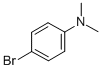
Product Name4-Bromo-N,N-dimethylanilineIUPAC Name4-bromo-N,N-dimethylanilineMolecular StructureCAS Registry Number 586-77-6EINECS Number209-582-2MDL NumberMFCD00000093Synonyms4-Bromo-N,N-dimethylaniline586-77-64-Dimethylaminobromobenzenep-Bromo-N,N-dimethylanilineN,N-Dimethyl-4-bromoanilineBenzenamine, 4-bromo-N,N-dimethyl-1-Bromo-4-(dimethylamino)benzenep-Dimethylaminobromobenzenep-(Dimethylamino)phenyl bromidep-Bromo(dimethylamino)benzenep-N,N-Dimethylaminobromobenzene4-(Dimethylamino)phenyl bromideAniline, p-bromo-N,N-dimethyl-ANILINE, 4-BROMO-N,N-DIMETHYL-NSC 8056EINECS 209-582-2N,NDimethylpbromoanilinepBromoN,NdimethylanilineN,NDimethyl4bromoanilinepDimethylaminobromobenzene4DimethylaminobromobenzeneAniline, pbromoN,NdimethylpBromo(dimethylamino)benzeneAniline, 4bromoN,NdimethylpN,NDimethylaminobromobenzene1Bromo4(dimethylamino)benzenep(Dimethylamino)phenyl bromide4(Dimethylamino)phenyl bromideBenzenamine, 4bromoN,NdimethylAniline, pbromoN,Ndimethyl (8CI)Aniline, p-bromo-N,N-dimethyl-(8CI)209-582-2inchi=1/c8h10brn/c1-10(2)8-5-3-7(9)4-6-8/h3-6h,1-2hN,N-Dimethyl-p-bromoanilineMFCD00000093(4-bromophenyl)dimethylamineK49ZS2E9KXNSC-80564-Bromo-N,N-dimethyl-benzenamine;N-(4-bromophenyl)-N,N-dimethylamine4-bromo-n,n-dimethyl aniline4-bromo-N,N-dimethyl-aniline(4-bromo-phenyl)-dimethyl-amineUNII-K49ZS2E9KX4-dimethylaminophenyl bromideSCHEMBL59844WLN: ER DN1&14-dimethylamino-1-bromobenzeneSCHEMBL86586044-Bromo-N,N-dimethylbenzenamineCHEMBL3098160DTXSID2060414NSC8056BCP306664-Bromo-N,N-dimethylaniline, 97%SBB058575AKOS005256709CS-W010495SB77477AC-22962DS-14421SY013736DB-053244A8294B0585NS00033993ST50405356EN300-19549D70593AC-509/25001966F9995-1667N,N-Dimethyl-p-bromoaniline pound>>4-Dimethylaminobromobenzene pound>>p-Bromo-N,N-dimethylanilineMolecular FormulaC8H10BrNMolecular Weight200.08InChIInChI=1S/C8H10BrN/c1-10(2)8-5-3-7(9)4-6-8/h3-6H,1-2H3InChI KeyXYZWMVYYUIMRIZ-UHFFFAOYSA-NSMILESCN(C)C1=CC=C(C=C1)Br
Patent InformationPatent IDTitlePublication DateCN117551052Oxadiazole derivative with antitumor activity and preparation method thereof2024CN118125962Method for preparing 2-aminomethylindoline-3-carboxylic acid from carbon dioxide2024CN117534632Dibenzophenophenylene selenazine compound as well as preparation method and application thereof2024CN118834121Method for preparing diaryl compound through cross coupling of diazonium salt and aryl bromide under nickel catalysis2024CN119191946Electrophilic cross-coupling method of aryl perfluorobutyl sulfonate and aryl bromide2024CN116730807Direct cross-coupling method of aryl phosphate and aryl bromide2023CN116730807Direct cross-coupling method of aryl phosphate and aryl bromide2023
Physical Data
AppearanceWhite crystal
Melting Point, °C Solvent (Melting Point) 48 - 5052 - 5452 - 54ethanol54 - 6147 - 4853 - 55diethyl ether51 - 53
Boiling Point, °CPressure (Boiling Point), Torr140 - 14289 - 901.5850.5264247722
Density, g·cm-3Reference Temperature, °CMeasurement Temperature, °C1.3218499.5
Description (Association (MCS))Solvent (Association (MCS))Temperature (Association (MCS)), °CPartner (Association (MCS))Stability constant of the complex with ...CCl4254-FluorophenolUV/VIS spectrum of the complexacetonitrilechloranilUV/VIS spectrum of the complexacetonitrileethenetetracarbonitrileNMR spectrum of the complexbenzene-d63,5-di-tert-butyl-o-benzoquinoneNMR spectrum of the complexbenzene-d63,5-di-tert-butyl-o-benzoquinone, 2-(N-p-bromophenyl-N-methyl)-aminomethoxy-4,6-di-tert-butylphenol, 3,5-Di-tert-butylcatecholFurther physical properties of the complexcyclohexane25anthraceneFurther physical properties of the complexcyclohexane251-chloroanthracene
Spectra
Description (NMR Spectroscopy)Nucleus (NMR Spectroscopy)Solvents (NMR Spectroscopy)Temperature (NMR Spectroscopy), °C Frequency (NMR Spectroscopy), MHzChemical shifts1Hchloroform-d1300Chemical shifts, Spectrum13Cchloroform-d175Chemical shifts, Spectrum1Hchloroform-d1Chemical shifts, Spectrum13Cchloroform-d1Chemical shifts, Spectrum13Cchloroform-d1Chemical shifts, Spectrum1Hchloroform-d124.84Chemical shifts, Spectrum13Cchloroform-d124.84
Description (IR Spectroscopy)Solvent (IR Spectroscopy)ATR (attenuated total reflectance), BandsBandsBandspotassium bromideBandspotassium bromideBandsparaffinBandsKBrBandsnujol
Description (UV/VIS Spectroscopy)Solvent (UV/VIS Spectroscopy)SpectrumN,N-dimethyl-formamideSpectrumdimethyl sulfoxidein the presence of additive(s), Spectrumdimethyl sulfoxideSpectrumSpectrumdimethyl sulfoxideSpectrumethanol
Route of Synthesis (ROS)
Route of Synthesis (ROS) of 4-Bromo-N,N-dimethylaniline CAS 586-77-6
ConditionsYieldWith phenylsilane; triphenylphosphine In tetrahydrofuran at 120℃; under 3750.38 Torr; for 24h; Autoclave; Green chemistry;99%With sodium tetrahydroborate In 1,4-dioxane at 100℃; under 7500.75 Torr; for 24h; Autoclave;93%With diphenylsilane; 1,3-dimesitylimidazol-2-ylidene In N,N-dimethyl-formamide at 50℃; under 760.051 Torr; chemoselective reaction;91%
Safety and Hazards
Pictogram(s)SignalWarningGHS Hazard StatementsH302 (98.4%): Harmful if swallowed H312 (96.9%): Harmful in contact with skin H315 (98.4%): Causes skin irritation H319 (98.4%): Causes serious eye irritation H332 (96.9%): Harmful if inhaled Precautionary Statement CodesP261, P264, P264+P265, P270, P271, P280, P301+P317, P302+P352, P304+P340, P305+P351+P338, P317, P321, P330, P332+P317, P337+P317, P362+P364, and P501(The corresponding statement to each P-code can be found at the GHS Classification page.)
Other Data
TransportationStore at around 0 ℃HS CodeStorageStore at around 0 ℃Shelf LifeHalf a yearMarket Price
DruglikenessLipinski rules componentMolecular Weight200.078logP3.029HBA1HBD0Matching Lipinski Rules4Veber rules componentPolar Surface Area (PSA)3.24Rotatable Bond (RotB)1Matching Veber Rules2
Use Pattern4-Bromo-N,N-dimethylaniline (CAS 586-77-6) is mainly used as an intermediate in the synthesis of pharmaceuticals, dyes, and organic electronic materials. https://www.chemwhat.com/4-bromo-nn-dimethylaniline-cas-586-77-6/

Comments
Post a Comment