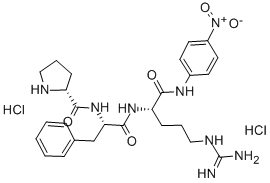

H-D-PRO-PHE-ARG-PNA 2 HCL CAS#: 62354-56-7
IdentificationPhysical DataSpectraRoute of Synthesis (ROS)Safety and HazardsOther Data

Identification

Product NameH-D-PRO-PHE-ARG-PNA 2 HCLIUPAC Name(2R)-N-amino]-1-oxo-3-phenylpropan-2-yl]pyrrolidine-2-carboxamide;dihydrochlorideMolecular StructureCAS Registry Number 62354-56-7Synonyms62354-56-7h-d-pro-phe-arg-pna 2 hclH-D-Pro-Phe-Arg-pNA . 2 HClD-Pro-Phe-Arg-pNA (hydrochloride)(2R)-N-amino]-1-oxo-3-phenylpropan-2-yl]pyrrolidine-2-carboxamide;dihydrochlorideH-D-Pro-Phe-Arg-pNA 2HClMFCD00274447SCHEMBL3277643H-D-Pro-Phe-Arg-pNA.2 HClS-2302 (Chromogenic substrate)?FP110816HY-138109CS-0145021Molecular FormulaC26H36Cl2N8O5Molecular Weight611.5InChIInChI=1S/C26H34N8O5.2ClH/c27-26(28)30-15-5-9-21(24(36)31-18-10-12-19(13-11-18)34(38)39)32-25(37)22(16-17-6-2-1-3-7-17)33-23(35)20-8-4-14-29-20;;/h1-3,6-7,10-13,20-22,29H,4-5,8-9,14-16H2,(H,31,36)(H,32,37)(H,33,35)(H4,27,28,30);2*1H/t20-,21+,22+;;/m1../s1InChI KeyCFOCUZJDBWPWPX-XZQQPLIMSA-NSMILESC1C(NC1)C(=O)N(CC2=CC=CC=C2)C(=O)N(CCCN=C(N)N)C(=O)NC3=CC=C(C=C3)(=O).Cl.Cl

Physical Data

AppearanceCrystalline solid

Spectra

No data available

Route of Synthesis (ROS)

No data available

Safety and Hazards

GHS Hazard StatementsNot Classified

Source: European Chemicals Agency (ECHA)License Note: Use of the information, documents and data from the ECHA website is subject to the terms and conditions of this Legal Notice, and subject to other binding limitations provided for under applicable law, the information, documents and data made available on the ECHA website may be reproduced, distributed and/or used, totally or in part, for non-commercial purposes provided that ECHA is acknowledged as the source: “Source: European Chemicals Agency, http://echa.europa.eu/”. Such acknowledgement must be included in each copy of the material. ECHA permits and encourages organisations and individuals to create links to the ECHA website under the following cumulative conditions: Links can only be made to webpages that provide a link to the Legal Notice page.License URL: https://echa.europa.eu/web/guest/legal-noticeRecord Name: (1-Cyano-2-ethoxy-2-oxoethylidenaminooxy)dimethylamino-morpholino-carbenium hexafluorophosphateURL: https://echa.europa.eu/information-on-chemicals/cl-inventory-database/-/discli/details/213446Description: The information provided here is aggregated from the “Notified classification and labelling” from ECHA’s C&L Inventory. Read more: https://echa.europa.eu/information-on-chemicals/cl-inventory-database

Other Data

TransportationLow temperature storage and transportationStorageLow temperature storage and transportationShelf Life2 years

DruglikenessLipinski rules componentMolecular Weight611.528logP2.316HBA10HBD7Matching Lipinski Rules2Veber rules componentPolar Surface Area (PSA)207.05Rotatable Bond (RotB)17Matching Veber Rules0 https://www.chemwhat.com/h-d-pro-phe-arg-pna-2-hcl-cas-62354-56-7/

Comments

Popular posts from this blog

BCB (Benzocyclobutene): — Watson International Enables the Transition from Concept to Scalable Application

Benzocyclobutene (BCB) is an organic compound with a rigid molecular structure composed of a conjugated benzene ring and a four-membered ring. Its excellent thermal stability and electrical properties have made it a highly promising candidate for next-generation electronic materials. Historically, its industrial adoption has been constrained by high production costs, complex purification processes, and limited output. However, with growing demand in high-end applications and recent advances in upstream technology, BCB is now poised for industrial-scale deployment. Material Properties and Structural Advantages BCB (C₈H₈) is a non-polar molecule, free of ester, carboxyl, or amide groups, giving it excellent dielectric properties and low moisture absorption. Its dielectric constant (Dk) and dissipation factor (Df) remain stable across wide temperature and frequency ranges—key metrics for ensuring signal integrity in high-frequency, high-speed communication systems. Unlike conventional m...

Overcoming the "Choke Points" in Semaglutide Side Chain Synthesis with Core Technologies to Enable Efficient GLP-1 Drug Manufacturing

Semaglutide, a groundbreaking product in the GLP-1 drug class, owes its extended half-life and enhanced receptor affinity largely to its unique side chain, Ste-Glu-AEEA-AEEA-OSU (CAS: 1169630-40-3) . This side chain covalently modifies the peptide backbone, significantly improving pharmacokinetics and therapeutic performance. However, its complex structure presents two critical synthetic challenges: Precise Assembly of Repetitive AEEA Units: The side chain features consecutive AEEA (aminoethoxyethoxyacetic acid) units, which require stepwise coupling via highly activated intermediates (e.g., AEEA-AEEA). Any impurities or deviations compromise downstream reaction efficiency and may trigger irreversible byproducts. Stereochemistry and Stability of Glutamic Acid (Glu): The glutamic acid component must maintain strict L-configuration, and its carboxyl groups require directional protection (e.g., OtBu) to preserve biological activity. Leveraging deep expertise in peptide chemistry a...

Empowering Innovation: ChemWhat's Organic Optoelectronic Ecosystem (Video)

A standout component of this lineup is the Fullerene C60 derivative, PC61BM. Widely recognized as a benchmark material, PC61BM plays a pivotal role not only in Organic Solar Cells (OSCs) but also in Perovskite Solar Cells (PSCs), where it functions as a highly efficient Electron Transport Layer (ETL) and grain boundary passivator. To address the varied requirements of universities, R&D centers, and commercial manufacturers, ChemWhat has standardized this product into two distinct purity levels: 99.5% for general research and 99.9% for high-precision device fabrication.