IdentificationPhysical DataSpectraRoute of Synthesis (ROS)Safety and HazardsOther Data
Identification
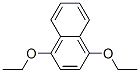
Product Name1,4-DiethoxynaphthaleneIUPAC Name1,4-diethoxynaphthalene Molecular StructureCAS Registry Number 27294-37-7MDL NumberMFCD17012247Synonyms1,4-Diethoxynaphthalene27294-37-7starbld0016416SCHEMBL50817Naphthalene, 1,4-diethoxy-DTXSID70500502BS-48837DB-083638F74697Molecular FormulaC14H16O2 Molecular Weight216.27InChIInChI=1S/C14H16O2/c1-3-15-13-9-10-14(16-4-2)12-8-6-5-7-11(12)13/h5-10H,3-4H2,1-2H3 InChI KeyLJSLYKNKVQMIJY-UHFFFAOYSA-NIsomeric SMILESCCOC1=CC=C(C2=CC=CC=C21)OCC
Physical Data
AppearanceSolid
Melting Point, °C 85 - 8784 - 85.589 - 90
Spectra
Description (NMR Spectroscopy)Nucleus (NMR Spectroscopy)Solvents (NMR Spectroscopy)Frequency (NMR Spectroscopy), MHzChemical shifts, Spectrum1Hdichloromethane-d2600Chemical shifts, Spectrum13Cdichloromethane-d2125Chemical shifts1HCDCl3Spin-spin coupling constantsCDCl3
Description (IR Spectroscopy)Solvent (IR Spectroscopy)Intensity of IR bands, BandsBandsneat (no solvent)
Route of Synthesis (ROS)
Route of Synthesis (ROS) of 1,4-Diethoxynaphthalene CAS 27294-37-7
ConditionsYieldWith potassium carbonate In acetone for 1h; Reflux;84%
Safety and Hazards
GHS Hazard StatementsNot Classified
Source: European Chemicals Agency (ECHA)License Note: Use of the information, documents and data from the ECHA website is subject to the terms and conditions of this Legal Notice, and subject to other binding limitations provided for under applicable law, the information, documents and data made available on the ECHA website may be reproduced, distributed and/or used, totally or in part, for non-commercial purposes provided that ECHA is acknowledged as the source: “Source: European Chemicals Agency, http://echa.europa.eu/”. Such acknowledgement must be included in each copy of the material. ECHA permits and encourages organisations and individuals to create links to the ECHA website under the following cumulative conditions: Links can only be made to webpages that provide a link to the Legal Notice page.License URL: https://echa.europa.eu/web/guest/legal-noticeRecord Name: (1-Cyano-2-ethoxy-2-oxoethylidenaminooxy)dimethylamino-morpholino-carbenium hexafluorophosphateURL: https://echa.europa.eu/information-on-chemicals/cl-inventory-database/-/discli/details/213446Description: The information provided here is aggregated from the “Notified classification and labelling” from ECHA’s C&L Inventory. Read more: https://echa.europa.eu/information-on-chemicals/cl-inventory-database
Other Data
DruglikenessLipinski rules componentMolecular Weight216.28logP3.964HBA0HBD0Matching Lipinski Rules4Veber rules componentPolar Surface Area (PSA)18.46Rotatable Bond (RotB)4Matching Veber Rules2
Use Patternit is used as a Precursor for Antioxidants and in dye and pigment manufacturing, helps prevent oxidation reactions. This is particularly useful in applications like polymers, oils, food additives, or chemical products, where it can slow down the degradation caused by oxidation.In dye and pigment synthesis, 1,4-diethoxynaphthalene acts as an essential building block, improving the solubility, lightfastness, and color saturation of the dye. Its ethoxy groups increase dye stability and enhance dispersion, making it adhere better to various materials.The compound can be integrated into the design of a wide range of dyes, leading to greater diversity in color performance. When used in special dyes, it can also improve durability and colorfastness, making it suitable for textiles, paints, and coatings. https://www.chemwhat.com/14-diethoxynaphthalene-cas-27294-37-7/

Comments
Post a Comment