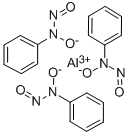
N-Nitroso-N-phenylhydroxylamine aluminum salt CAS#: 15305-07-4
IdentificationPhysical DataSpectraRoute of Synthesis (ROS)Safety and HazardsOther Data

Identification

Product NameN-Nitroso-N-phenylhydroxylamine aluminum saltIUPAC Namealuminum;(Z)-oxido-oxidoimino-phenylazanium  Molecular StructureCAS Registry Number 15305-07-4Synonyms15305-07-4Aluminum N-nitrosophenylhydroxylamineN-Nitroso-N-phenylhydroxylamine aluminum saltMFCD00144989Aluminum, tris-EINECS 239-341-7AKOS015901701aluminum;(Z)-oxido-oxidoimino-phenylazaniumTris(N-hydroxy-N-nitrosophenylaminato-O,O')aluminiumAluminum, tris(N-hydroxy-N-nitrosobenzenaminato-O,O')-Molecular FormulaC18H15AlN6O6Molecular Weight438.3InChIInChI=1S/3C6H6N2O2.Al/c3*9-7-8(10)6-4-2-1-3-5-6;/h3*1-5,9H;/q;;;+3/p-3/b3*8-7-; InChI KeyMKSISPKJEMTIGI-LWTKGLMZSA-K Isomeric SMILESC1=CC=C(C=C1)/(=N/)/.C1=CC=C(C=C1)/(=N/)/.C1=CC=C(C=C1)/(=N/)/.

Physical Data

AppearanceOff-white to light yellow powder

Density, g·cm-3Measurement Temperature, °C1.37922.841.394

Spectra

No data available

Route of Synthesis (ROS)

No data available

Safety and Hazards

Pictogram(s)SignalDangerGHS Hazard StatementsH302 (78.8%): Harmful if swallowed H317 (78.8%): May cause an allergic skin reaction H350 (36.1%): May cause cancer H400 (67.2%): Very toxic to aquatic life H410 (73.4%): Very toxic to aquatic life with long lasting effects Precautionary Statement CodesP203, P261, P264, P270, P272, P273, P280, P301+P317, P302+P352, P318, P321, P330, P333+P317, P362+P364, P391, P405, and P501(The corresponding statement to each P-code can be found at the GHS Classification page.)

Other Data

TransportationUnder room temperature, Sealed and away from lightHS CodeStorageUnder room temperature, Sealed and away from lightShelf Life1 yearMarket Price

DruglikenessLipinski rules componentMolecular Weight438.335logPHBA0HBD0Matching Lipinski Rules3Veber rules componentPolar Surface Area (PSA)46.8Rotatable Bond (RotB)3Matching Veber Rules2

Use PatternN-Nitroso-N-phenylhydroxylamine aluminum salt is a highly effective inhibitor. Its main function is to extend the storage time of UV formulas and prevent the self-polymerization of UV coatings and ink formulas during storage.Preventing self-polymerization greatly enhances the stability of UV formulations, ensuring that the physical and chemical properties remain unchanged during storage, thereby maintaining their performance when used.Extending the storage life of UV formulations reduces the rate of product failure, lowering production and inventory management costs.Stable formulations reduce concerns about fluctuations in raw material quality and performance during production, improving production efficiency.Reducing waste and loss helps lower environmental impact, aligning with sustainable development principles. Stable product storage performance reduces the number of expired chemicals discarded, thereby lowering the risk of environmental pollution.
https://www.chemwhat.com/n-nitroso-n-phenylhydroxylamine-aluminum-salt-cas-15305-07-4/

Comments

Popular posts from this blog

Watson's PDHP CAS 34562-31-7 The Secret to Light Yellow Liquid Appearance

In the competitive world of chemical manufacturing, maintaining consistency and meeting precise specifications are essential for success. One compound that highlights these principles is 3,5-Diethyl-1,2-dihydro-1-phenyl-2-propylpyridine, commonly known as PDHP, with the CAS number 34562-31-7. PDHP is a versatile compound utilized in various industrial applications, including rubber additives and catalytic processes. Among its many attributes, Watson’s ability to consistently produce PDHP as a light yellow liquid stands out, especially in industries where the appearance of the final product is crucial. PDHP serves a vital role in several industrial sectors. In the rubber industry, it functions as an additive that enhances the durability and longevity of rubber products. PDHP’s properties help improve the stability of rubber, making it more resistant to environmental wear and tear. Additionally, in catalysis, PDHP’s structure allows it to act as an effective ligand or catalyst precurso...
IdentificationPhysical DataSpectraRoute of Synthesis (ROS)Safety and HazardsOther Data Identification Product Namemethylammonium iodideIUPAC Namemethylazanium;iodide Molecular StructureCAS Registry Number 14965-49-2MDL NumberMFCD28100833SynonymsMethylammonium iodide14965-49-2methylazanium;iodideEINECS 239-037-4methylazanium iodideMethanamine, hydriodideMethyl ammonium iodideMethylamine.hydriodicacidSCHEMBL1534750Methylammonium Iodide, anhydrousDB-221235NS00086090Molecular FormulaCH6INMolecular Weight158.97InChIInChI=1S/CH5N.HI/c1-2;/h2H2,1H3;1HInChI KeyLLWRXQXPJMPHLR-UHFFFAOYSA-N  Canonical SMILESC. Patent InformationPatent IDTitlePublication DateWO2023/180219A METHOD FOR SYNTHESIS OF HALIDE SALTS2023CN113845428Preparation method of perovskite material powder2021WO2018/169373METHOD OF PREPARING LUMINESCENT NANO-SHEET, LUMINESCENT NANO-SHEET MATERIAL, LUMINESCENT NANO-SHEET FILM, BACK LIGHT, AND LIQUID CRYSTAL DISPLAY APPARATUS2018WO2015/32748AMORPHOUS MATERIAL AND THE USE THEREOF2018 ...
IdentificationPhysical DataSpectraRoute of Synthesis (ROS)Safety and HazardsOther Data Identification Product NameNickel HydroxideIUPAC Namenickel;dihydrate Molecular StructureCAS Registry Number 12054-48-7EINECS Number235-008-5MDL NumberMFCD00011140Beilstein Registry NumberSynonyms12054-48-7AKOS015903693CS-0089243dihydroxynickelEC 235-008-5EINECS 235-008-5HSDB 1827LS-96321MFCD00011140Nickel dihydroxideNickel hydroxide (II)Nickel hydroxide (Ni(OH)2)Nickel hydroxide (ous)Nickel Hydroxide nanowireNickel(2+) hydroxidenickel(II) dihydroxideNickel(II) hydroxide, for analysisnickel;dihydrateNickelous hydroxideUNII-L8UW92NW6JMolecular FormulaH4NiO2Molecular Weight94.724 InChIInChI=1S/Ni.2H2O/h;2*1H2 InChI KeyAIBQNUOBCRIENU-UHFFFAOYSA-N  Canonical SMILESO.O.   Physical Data AppearanceGreen powder Spectra Description (IR Spectroscopy)Solvent (IR Spectroscopy)Temperature (IR Spectroscopy), °CBandssolid matrix-258 Description (UV/VIS Spectroscopy)Solvent (UV/VIS Spectroscopy)Comment (UV/VIS Spec...