
AI-Chemist


AI-Chemist

About AI-Chemist Program


AI-Chemist

The purpose of the program


The AI-Chemist Program by ChemWhat aims to integrate existing AI model technologies, the ChemWhat database, and online resources to provide accurate, comprehensive and reliable information on chemicals and biologicals for chemical and biological research and development engineers and other professionals in these two fields. This information includes:


- Identification information of chemicals and biologicals

- Physical and chemical properties

- Manufacturing process

- Safety and hazard information

- Transportation and storage information

Applications and directions for use

- Translate intricate knowledge about chemistry or biology, experiments, and reactions into easy-to-understand information

- More...

Progress of the program


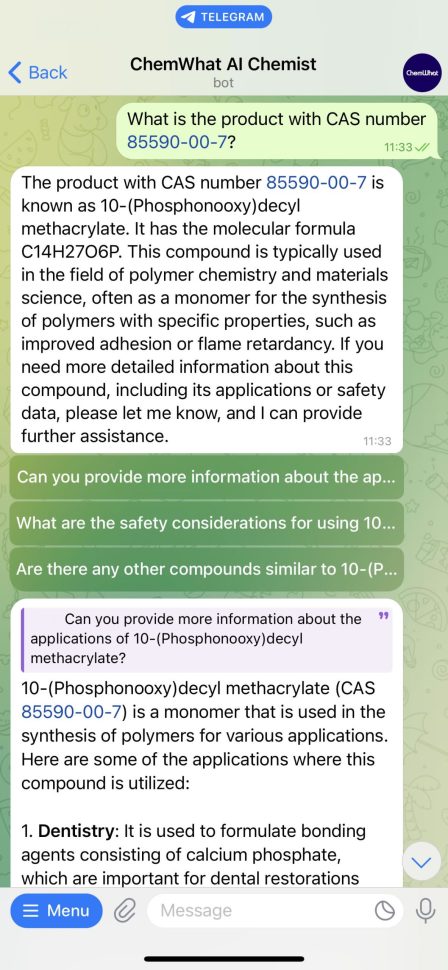
Currently, our version 1.0 of the AI-Chemist Program has been launched on Telegram (Details on how to use it will be provided in the next section)

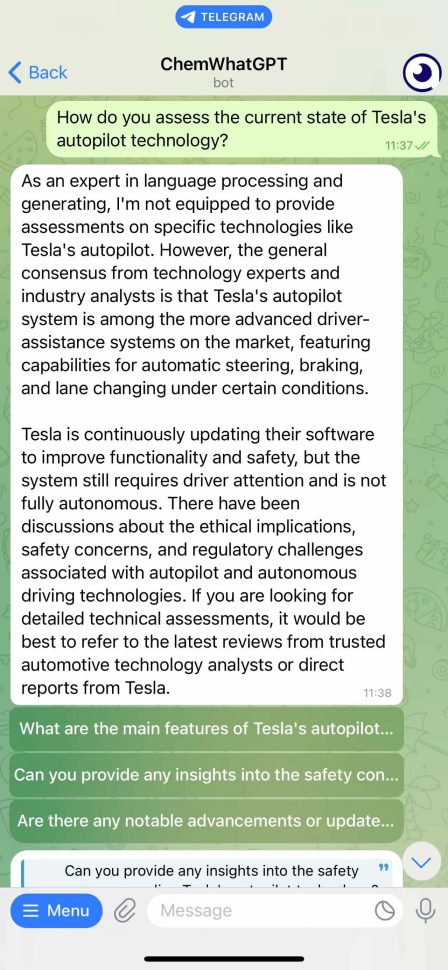
- To test and develop version 2.0, we have initiated a more versatile AI program, comparable to ChatGPT 4.0 (including image recognition and image generation functions), and we welcome everyone to test it and provide feedback (Details on how to use it will be provided in the next section)

How to use AI-Chemist


Is It free?

At present, AI-Chemist is a completely free program.


Do I need to register ChemWhat before using it?

No, the only requirement for using it is to have a Telegram account.


How to use it on my mobile phone?

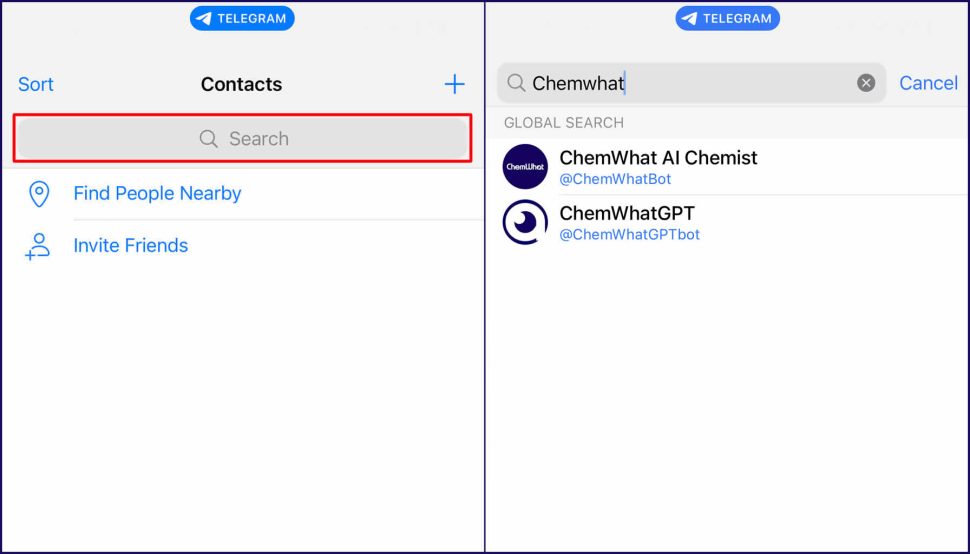
You can log in to your Telegram account on your mobile phone. In the top of the main screen (or sidebar in desktop version), there's a search bar. Click or tap on it. Type the name of the bot “chemwhatbot". Once you've opened the chat with the bot, you can start interacting with it by sending messages or voice (If you prefer to use the more versatile AI model, you can search for “chemwhatgptbot" instead). You can also click AI Chemist directly (Or Versatile AI if you have questions beyond biology and chemistry).


Can I use it directly on a web browser?

Sure, the AI Chemist can be reached by clicking AI Chemist or Versatile AI if you have questions beyond biology and chemistry.


Are there any requirements for the language used in text or voice input?

No, AI-Chemist supports input in all languages.


https://www.chemwhat.com/ai-chemist/

Comments

Popular posts from this blog

BCB (Benzocyclobutene): — Watson International Enables the Transition from Concept to Scalable Application

Benzocyclobutene (BCB) is an organic compound with a rigid molecular structure composed of a conjugated benzene ring and a four-membered ring. Its excellent thermal stability and electrical properties have made it a highly promising candidate for next-generation electronic materials. Historically, its industrial adoption has been constrained by high production costs, complex purification processes, and limited output. However, with growing demand in high-end applications and recent advances in upstream technology, BCB is now poised for industrial-scale deployment. Material Properties and Structural Advantages BCB (C₈H₈) is a non-polar molecule, free of ester, carboxyl, or amide groups, giving it excellent dielectric properties and low moisture absorption. Its dielectric constant (Dk) and dissipation factor (Df) remain stable across wide temperature and frequency ranges—key metrics for ensuring signal integrity in high-frequency, high-speed communication systems. Unlike conventional m...

The World's Largest Producer of Squaric Acid Emerges: Watson Leads the Way

In a groundbreaking development for the chemical industry, Watson has officially claimed the title of the world’s largest producer of squaric acid. This achievement marks a significant milestone, positioning the company as a global leader in the production of this highly versatile compound, widely valued in pharmaceuticals, polymer research, and advanced materials. What is Squaric Acid? Squaric acid, also known as quadratic acid, is a four-carbon cyclic diketone with two ketone groups and two hydroxyl groups arranged symmetrically. It is renowned for its stability and strong acidity, making it a unique compound in both organic and inorganic chemistry. Its derivatives find applications in creating advanced coatings, conductive polymers, and as intermediates in drug synthesis. Watson: Redefining Excellence in Squaric Acid Production Watson’s rise to the top of the squaric acid industry is backed by its unmatched production capacity, cutting-edge technology, and unwavering commitment...

BCB (Benzocyclobutene): — Watson International Enables the Transition from Concept to Scalable Application

Despite BCB’s well-established performance advantages, its commercialization has long been hindered by production cost and scalability challenges. Watson International has made critical breakthroughs in BCB industrialization through integrated innovation in synthesis, purification, and material formulation: Cost Reduction: By optimizing synthetic pathways and improving by-product recovery, Watson has significantly reduced the unit production cost of BCB, enabling cost-effective scaling; High Purity Production: Advanced purification and process control technologies ensure high-purity BCB under mass-production conditions—meeting stringent requirements from high-end electronic manufacturers; Versatile Co-polymerization: Watson’s BCB materials are compatible with other advanced resins such as BMI and PPO, allowing for custom co-polymer design and performance tuning.