IdentificationPhysical DataSpectraRoute of Synthesis (ROS)Safety and HazardsOther Data
Identification
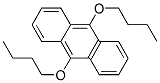
Product Name9,10-DibutoxyanthraceneIUPAC Name9,10-dibutoxyanthraceneMolecular StructureCAS Registry Number 76275-14-4EINECS NumberNo data available MDL NumberNo data available Beilstein Registry NumberNo data availableSynonyms9,10-dibutoxyanthracene9,10-dibutoxyanthracene; AK-97075; Anthracene,9,10-dibutoxy-; SCHEMBL442080; CTK5E2705; KS-00000QJI; DTXSID20621211; C22H26O2; 1866AC; ANW-60112; ZINC77051484; AKOS016004436; AS-10114; AX8237457; ST2406611; TX-017400; 4CH-017170; CS-0032534; FT-0699474; 76275-14-4Molecular FormulaC22H26O2Molecular Weight322.4InChIInChI=1S/C22H26O2/c1-3-5-15-23-21-17-11-7-9-13-19(17)22(24-16-6-4-2)20-14-10-8-12-18(20)21/h7-14H,3-6,15-16H2,1-2H3InChI KeyKSMGAOMUPSQGTB-UHFFFAOYSA-NCanonical SMILESCCCCOC1=C2C=CC=CC2=C(C3=CC=CC=C31)OCCCC
Patent InformationPatent IDTitlePublication DateNo data available
Physical Data
AppearanceLight yellow powderMelting Point108.0-113.0 ºC
Spectra
9,10-Dibutoxyanthracene CAS#: 76275-14-4 UV Absorption Spectrum
Route of Synthesis (ROS)
No data available
Safety and Hazards
GHS Hazard StatementsH413: May cause long lasting harmful effects to aquatic life Information may vary between notifications depending on impurities, additives, and other factors. Precautionary Statement CodesP273, and P501(The corresponding statement to each P-code can be found at the GHS Classification page.)
Source: European Chemicals Agency (ECHA)License Note: Use of the information, documents and data from the ECHA website is subject to the terms and conditions of this Legal Notice, and subject to other binding limitations provided for under applicable law, the information, documents and data made available on the ECHA website may be reproduced, distributed and/or used, totally or in part, for non-commercial purposes provided that ECHA is acknowledged as the source: “Source: European Chemicals Agency, http://echa.europa.eu/”. Such acknowledgement must be included in each copy of the material. ECHA permits and encourages organisations and individuals to create links to the ECHA website under the following cumulative conditions: Links can only be made to webpages that provide a link to the Legal Notice page.License URL: https://echa.europa.eu/web/guest/legal-noticeDescription: The information provided here is aggregated from the “Notified classification and labelling” from ECHA’s C&L Inventory. Read more: https://echa.europa.eu/information-on-chemicals/cl-inventory-database
Other Data
TransportationNot dangerous goodsUnder the room temperature and away from light. It is sensitive to light and must be kept away from light strictly.HS Code294200StorageUnder the room temperature and away from light. It is sensitive to light and must be kept away from light strictly.Shelf Life1 yearMarket PriceUSD 950/kg
Use Pattern9,10-dibutoxyanthracene CAS 76275-14-4 is a photosensitizer for UV cationic polymerization. It has a unique absorption zone of long UV wavelengths over 400 nm. It provides effective energy transfer to the photopolymerization initiator, leading to accelerated polymerization and improved surface properties and adhesiveness of the cured product. Making long-wavelength UV radiation available for photopolymerization, the photosensitizer now permits thick-film cationic polymerization which in conventional systems would end up in insufficient curing. It is used in dental restorative, UV ink, photoresist, welding mask, electronic coating and UV curable adhesive.
https://www.chemwhat.com/910-dibutoxyanthracene-cas-76275-14-4/

Comments
Post a Comment