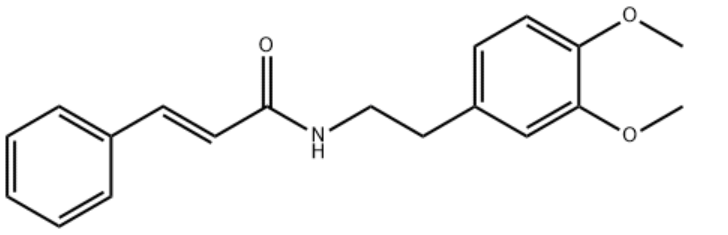
Lemairamin CAS#: 29946-61-0
IdentificationPhysical DataSpectraRoute of Synthesis (ROS)Safety and HazardsOther Data

Identification

Product NameLemairaminMolecular StructureCAS Registry Number 29946-61-0MDL NumberMFCD00610628Synonyms2-Propenamide, N--3-phenyl-, (2E)-;Lemairamin (WGX-50)Molecular FormulaC19H21NO3Molecular Weight311.37

Physical Data

AppearanceWhite powder

Melting Point, °C Solvent (Melting Point) 124 - 126132124.5 - 126acetone119 - 120toluene122 - 124acetone, hexane127aq. ethanol

Spectra

Description (NMR Spectroscopy)Nucleus (NMR Spectroscopy)Solvents (NMR Spectroscopy)Temperature (NMR Spectroscopy), °C Frequency (NMR Spectroscopy), MHzChemical shifts1Hchloroform-d1500Chemical shifts13Cchloroform-d1125Chemical shifts1Hdimethylsulfoxide-d6300Chemical shifts, Spectrum1Hchloroform-d1300Chemical shifts, Spectrum13Cchloroform-d124.84125

Description (IR Spectroscopy)Solvent (IR Spectroscopy)Bandsneat (no solvent, solid phase)BandsKBr

Description (UV/VIS Spectroscopy)Solvent (UV/VIS Spectroscopy)Comment (UV/VIS Spectroscopy)Absorption Maxima (UV/VIS), nmExt./Abs. Coefficient, l·mol-1cm-1Absorption maximamethanol206, 277

Route of Synthesis (ROS)

Route of Synthesis (ROS) of Lemairamin CAS 29946-61-0

ConditionsYieldWith sodium hydroxide In dichloromethane at 20℃; for 3h; Schotten-Baumann Reaction;91%With sodium hydroxide In dichloromethane; water at 20℃; for 3h; Schotten-Baumann Reaction;91%Experimental Procedure An amount of 458mg of cinnamoyl chloride (2.76mmol) dissolved in CH2Cl2 (1mL) was added dropwise at 0°C to a solution of 2-(3,4-dimethoxyphenyl)ethylamine (500mg, 2.76mmol) in CH2Cl2 (20mL) and 5% aqueous NaOH (4.4mL) with stirring at room temperature for 3h. Then, the mixture was stirred with 2.5% aqueous HCl. The organic solution was washed with brine (2×10ml) and H2O (2×10ml), dried over anhydrous Na2SO4 and evaporated to dryness. The residue obtained was purified by silica gel column chromatography (Hexane/CH2Cl2/EtOAc, 20:70:10) to afford the acetamide 1 (781mg, 91%) as a white oil. 1H NMR (500MHz, CDCl3): δ=7.62 (d, J=15.6Hz, 1H, CH-β).

Safety and Hazards

No data available

Other Data

TransportationUnder room temperature and away from lightHS CodeStorageUnder the room temperature and away from lightShelf Life2 yearsMarket Price

Toxicity/Safety PharmacologyQuantitative Results

Use PatternLemairamin CAS#: 29946-61-0 used as the next generation of anti-aging material. And Lemairamin has some applications in the medical field, primarily due to its effects on the nervous system.
https://www.chemwhat.com/lemairamin-cas-29946-61-0/

Comments

Popular posts from this blog

BCB (Benzocyclobutene): — Watson International Enables the Transition from Concept to Scalable Application

Benzocyclobutene (BCB) is an organic compound with a rigid molecular structure composed of a conjugated benzene ring and a four-membered ring. Its excellent thermal stability and electrical properties have made it a highly promising candidate for next-generation electronic materials. Historically, its industrial adoption has been constrained by high production costs, complex purification processes, and limited output. However, with growing demand in high-end applications and recent advances in upstream technology, BCB is now poised for industrial-scale deployment. Material Properties and Structural Advantages BCB (C₈H₈) is a non-polar molecule, free of ester, carboxyl, or amide groups, giving it excellent dielectric properties and low moisture absorption. Its dielectric constant (Dk) and dissipation factor (Df) remain stable across wide temperature and frequency ranges—key metrics for ensuring signal integrity in high-frequency, high-speed communication systems. Unlike conventional m...

The World's Largest Producer of Squaric Acid Emerges: Watson Leads the Way

In a groundbreaking development for the chemical industry, Watson has officially claimed the title of the world’s largest producer of squaric acid. This achievement marks a significant milestone, positioning the company as a global leader in the production of this highly versatile compound, widely valued in pharmaceuticals, polymer research, and advanced materials. What is Squaric Acid? Squaric acid, also known as quadratic acid, is a four-carbon cyclic diketone with two ketone groups and two hydroxyl groups arranged symmetrically. It is renowned for its stability and strong acidity, making it a unique compound in both organic and inorganic chemistry. Its derivatives find applications in creating advanced coatings, conductive polymers, and as intermediates in drug synthesis. Watson: Redefining Excellence in Squaric Acid Production Watson’s rise to the top of the squaric acid industry is backed by its unmatched production capacity, cutting-edge technology, and unwavering commitment...

BCB (Benzocyclobutene): — Watson International Enables the Transition from Concept to Scalable Application

Despite BCB’s well-established performance advantages, its commercialization has long been hindered by production cost and scalability challenges. Watson International has made critical breakthroughs in BCB industrialization through integrated innovation in synthesis, purification, and material formulation: Cost Reduction: By optimizing synthetic pathways and improving by-product recovery, Watson has significantly reduced the unit production cost of BCB, enabling cost-effective scaling; High Purity Production: Advanced purification and process control technologies ensure high-purity BCB under mass-production conditions—meeting stringent requirements from high-end electronic manufacturers; Versatile Co-polymerization: Watson’s BCB materials are compatible with other advanced resins such as BMI and PPO, allowing for custom co-polymer design and performance tuning.