IdentificationPhysical DataSpectraRoute of Synthesis (ROS)Safety and HazardsOther Data
Identification
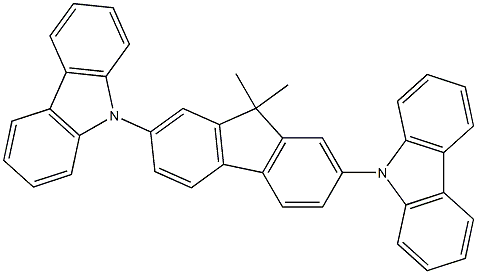
Product NameDMFL-CBP 2,7-Bis(carbazol-9-yl)-9,9-dimethylfluoreneIUPAC Name9-(7-carbazol-9-yl-9,9-dimethylfluoren-2-yl)carbazole Molecular StructureCAS Registry Number 226958-06-1Synonyms226958-06-19,9'-(9,9-Dimethyl-9H-fluorene-2,7-diyl)bis(9H-carbazole)9-(7-carbazol-9-yl-9,9-dimethylfluoren-2-yl)carbazole2,7-Bis(carbazol-9-yl)-9,9-dimethylfluorene2,7-Bis(9H-carbazol-9-yl)-9,9-dimethylfluoreneDMFL-CBP 2,7-Bis(carbazol-9-yl)-9,9-dimethylfluoreneDMFL-CBPSCHEMBL2754646DTXSID10697627BJA95806MFCD12022460AS-39345B4960CS-03363372,7-Bis(9H-carbazole-9-yl)-9,9-dimethyl-9H-fluorene9,9'-(9,9-Dimethyl-9H-fluorene-2,7-diyl)di(9H-carbazole)9,9-(9,9-Dimethyl-9H-fluorene-2,7-diyl)bis9,9(2)-(9,9-Dimethyl-9H-fluorene-2,7-diyl)bis-9H-carbazoleMolecular FormulaC39H28N2Molecular Weight524.7InChI InChI=1S/C39H28N2/c1-39(2)33-23-25(40-35-15-7-3-11-29(35)30-12-4-8-16-36(30)40)19-21-27(33)28-22-20-26(24-34(28)39)41-37-17-9-5-13-31(37)32-14-6-10-18-38(32)41/h3-24H,1-2H3 InChI KeyIEQGNDONCZPWMW-UHFFFAOYSA-N
Patent InformationPatent IDTitlePublication DateUS2022/213113NITROGEN-CONTAINING CONDENSED CYCLIC COMPOUNDS, FLUORESCENCE EMITTERS, ORGANIC ELECTROLUMINESCENT DEVICES, AND MATERIALS FOR ORGANIC ELECTROLUMINESCENT DEVICES2022KR2015/66429Organic Compound and Organic Light Emitting Diode Devices using the same2015
Physical Data
AppearanceWhite powder
Spectra
Description (NMR Spectroscopy)Nucleus (NMR Spectroscopy)Solvents (NMR Spectroscopy)Chemical shifts, Spectrum1Hchloroform-d1Chemical shifts, Spectrum13Cchloroform-d1
Description (UV/VIS Spectroscopy)Solvent (UV/VIS Spectroscopy)Absorption Maxima (UV/VIS), nmSpectrumtoluene342Spectrumneat (no solvent, solid phase)374Spectrumdichloromethane360
Route of Synthesis (ROS)
Route of Synthesis (ROS) of DMFL-CBP 2,7-Bis(carbazol-9-yl)-9,9-dimethylfluorene CAS: 226958-06-1
ConditionsYieldWith potassium phosphate; copper(l) iodide; trans-1,2-Diaminocyclohexane In 1,4-dioxane for 12h; Reflux;67%Experimental Procedure10 g (28.403 mmol) of 2,7-dibromo-9,9-dimethyl-9H-fluorene, 9.5 g (56.806 mmol) of carbazole, 4.3 g (22.722 mmol) of copper iodide 36 g (170.418 mmol) of potassium (K3PO4) and 2.7 ml (22.722 mmol) of trans-1,2-cyclohexanediamine were dissolved in 1,4-dioxane and stirred under reflux for 12 hours . After completion of the reaction, the reaction mixture was distilled under reduced pressure to remove the solvent. The solvent was distilled off, and the residue was subjected to column chromatography using a solvent mixture of n-hexane and methylene chloride (4: 1) The solvent was distilled off under reduced pressure and the residue was recrystallized in a solvent of methylene chloride and petroleum ether to obtain 4.0 g (yield: 67%) of compound FL-1.
Safety and Hazards
No data available
Other Data
TransportationUnder room temperature away from lightHS CodeStorageUnder room temperature away from lightShelf Life2 yearsMarket Price
DruglikenessLipinski rules componentMolecular Weight524.665logP12.01HBA2HBD0Matching Lipinski Rules2Veber rules componentPolar Surface Area (PSA)9.86Rotatable Bond (RotB)2Matching Veber Rules2
Use PatternDMFL-CBP 2,7-Bis(carbazol-9-yl)-9,9-dimethylfluorene CAS#: 226958-06-1 is widely used as a catalyst or reagent in organic synthesis reactions.
https://www.chemwhat.com/dmfl-cbp-27-biscarbazol-9-yl-99-dimethylfluorene-cas-226958-06-1/

Comments
Post a Comment