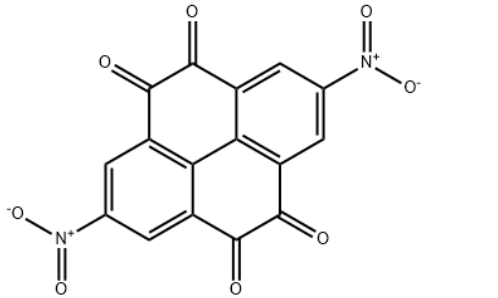
2,7-dinitropyrene-4,5,9,10-tetraone CAS#: 2151811-65-1
IdentificationPhysical DataSpectraRoute of Synthesis (ROS)Safety and HazardsOther Data

Identification

Product Name2,7-dinitropyrene-4,5,9,10-tetraoneIUPAC NameMolecular StructureCAS Registry Number 2151811-65-1Molecular FormulaC16H4N2O8Molecular Weight352.21InChIInChI KeyCanonical SMILES

Physical Data

Appearance

Spectra

Description (NMR Spectroscopy)Nucleus (NMR Spectroscopy)Solvents (NMR Spectroscopy)Temperature (NMR Spectroscopy), °C Frequency (NMR Spectroscopy), MHzChemical shifts, Spectrum1Hdimethylsulfoxide-d624.84300Chemical shifts13Cdimethylsulfoxide-d6500

2,7-dinitropyrene-4,5,9,10-tetraone CAS#: 2151811-65-1 NMR

Description (IR Spectroscopy)Solvent (IR Spectroscopy)Temperature (IR Spectroscopy), °CBandspotassium bromide

Description (UV/VIS Spectroscopy)Solvent (UV/VIS Spectroscopy)N,N-dimethyl-formamide279, 343Absorption maximaH2O, NaOH

Route of Synthesis (ROS)

Route of 2,7-dinitropyrene-4,5,9,10-tetraone CAS#: 2151811-65-1

ConditionsYieldWith sulfuric acid; nitric acid at 85℃; for 0.75h; Cooling with ice;82%With sulfuric acid; nitric acid at 90℃; for 2h;75.6%With sulfuric acid; nitric acid at 90℃;75.6%With sulfuric acid; nitric acid at 90℃;75.6 %1.2 2) Synthesis of 2,7-dinitro-4,5,9,10-tetrahydropyrene-4,5,9,10-tetrone (III):Weigh 4,5,9,10-tetrahydropyrene-4,5,9,10-tetrone(II, 5g, 3.8mmol) into a 250mL two-necked round bottom flask,Concentrated sulfuric acid (50 mL) was added, and then fuming nitric acid (50 mL) was slowly added dropwise in an ice bath. The device is placed in an oil bath at 85°C and refluxed for 45 minutes. After the reaction solution is cooled to room temperature, it is poured into a beaker with ice.After the ice is completely melted, suction filter, and the filter cake is washed with water.It was dried in vacuum at room temperature to obtain a pale yellow solid 2,7-dinitro-4,5,9,10-tetrahydropyrene-4,5,9,10-tetrone(III) (5.48 g, yield 82%).

Safety and Hazards

No data available

Other Data

TransportationUnder the room temperature and away from lightHS CodeStorageUnder the room temperature and away from lightShelf Life1 yearMarket Price

DruglikenessLipinski rules componentMolecular Weight352.216logP2.038HBA4HBD0Matching Lipinski Rules4Veber rules componentPolar Surface Area (PSA)159.92Rotatable Bond (RotB)2Matching Veber Rules1

Toxicity/Safety PharmacologyQuantitative Results

Use Pattern2,7-dinitropyrene-4,5,9,10-tetraone CAS#: 2151811-65-1 is used as a OLED material
https://www.chemwhat.com/27-dinitropyrene-45910-tetraone-cas%ef%bc%9a-2151811-65-1/

Comments

Popular posts from this blog

Watson's PDHP CAS 34562-31-7 The Secret to Light Yellow Liquid Appearance

In the competitive world of chemical manufacturing, maintaining consistency and meeting precise specifications are essential for success. One compound that highlights these principles is 3,5-Diethyl-1,2-dihydro-1-phenyl-2-propylpyridine, commonly known as PDHP, with the CAS number 34562-31-7. PDHP is a versatile compound utilized in various industrial applications, including rubber additives and catalytic processes. Among its many attributes, Watson’s ability to consistently produce PDHP as a light yellow liquid stands out, especially in industries where the appearance of the final product is crucial. PDHP serves a vital role in several industrial sectors. In the rubber industry, it functions as an additive that enhances the durability and longevity of rubber products. PDHP’s properties help improve the stability of rubber, making it more resistant to environmental wear and tear. Additionally, in catalysis, PDHP’s structure allows it to act as an effective ligand or catalyst precurso...

The World's Largest Producer of Squaric Acid Emerges: Watson Leads the Way

In a groundbreaking development for the chemical industry, Watson has officially claimed the title of the world’s largest producer of squaric acid. This achievement marks a significant milestone, positioning the company as a global leader in the production of this highly versatile compound, widely valued in pharmaceuticals, polymer research, and advanced materials. What is Squaric Acid? Squaric acid, also known as quadratic acid, is a four-carbon cyclic diketone with two ketone groups and two hydroxyl groups arranged symmetrically. It is renowned for its stability and strong acidity, making it a unique compound in both organic and inorganic chemistry. Its derivatives find applications in creating advanced coatings, conductive polymers, and as intermediates in drug synthesis. Watson: Redefining Excellence in Squaric Acid Production Watson’s rise to the top of the squaric acid industry is backed by its unmatched production capacity, cutting-edge technology, and unwavering commitment...
IdentificationPhysical DataSpectraRoute of Synthesis (ROS)Safety and HazardsOther Data Identification Product Namemethylammonium iodideIUPAC Namemethylazanium;iodide Molecular StructureCAS Registry Number 14965-49-2MDL NumberMFCD28100833SynonymsMethylammonium iodide14965-49-2methylazanium;iodideEINECS 239-037-4methylazanium iodideMethanamine, hydriodideMethyl ammonium iodideMethylamine.hydriodicacidSCHEMBL1534750Methylammonium Iodide, anhydrousDB-221235NS00086090Molecular FormulaCH6INMolecular Weight158.97InChIInChI=1S/CH5N.HI/c1-2;/h2H2,1H3;1HInChI KeyLLWRXQXPJMPHLR-UHFFFAOYSA-N  Canonical SMILESC. Patent InformationPatent IDTitlePublication DateWO2023/180219A METHOD FOR SYNTHESIS OF HALIDE SALTS2023CN113845428Preparation method of perovskite material powder2021WO2018/169373METHOD OF PREPARING LUMINESCENT NANO-SHEET, LUMINESCENT NANO-SHEET MATERIAL, LUMINESCENT NANO-SHEET FILM, BACK LIGHT, AND LIQUID CRYSTAL DISPLAY APPARATUS2018WO2015/32748AMORPHOUS MATERIAL AND THE USE THEREOF2018 ...